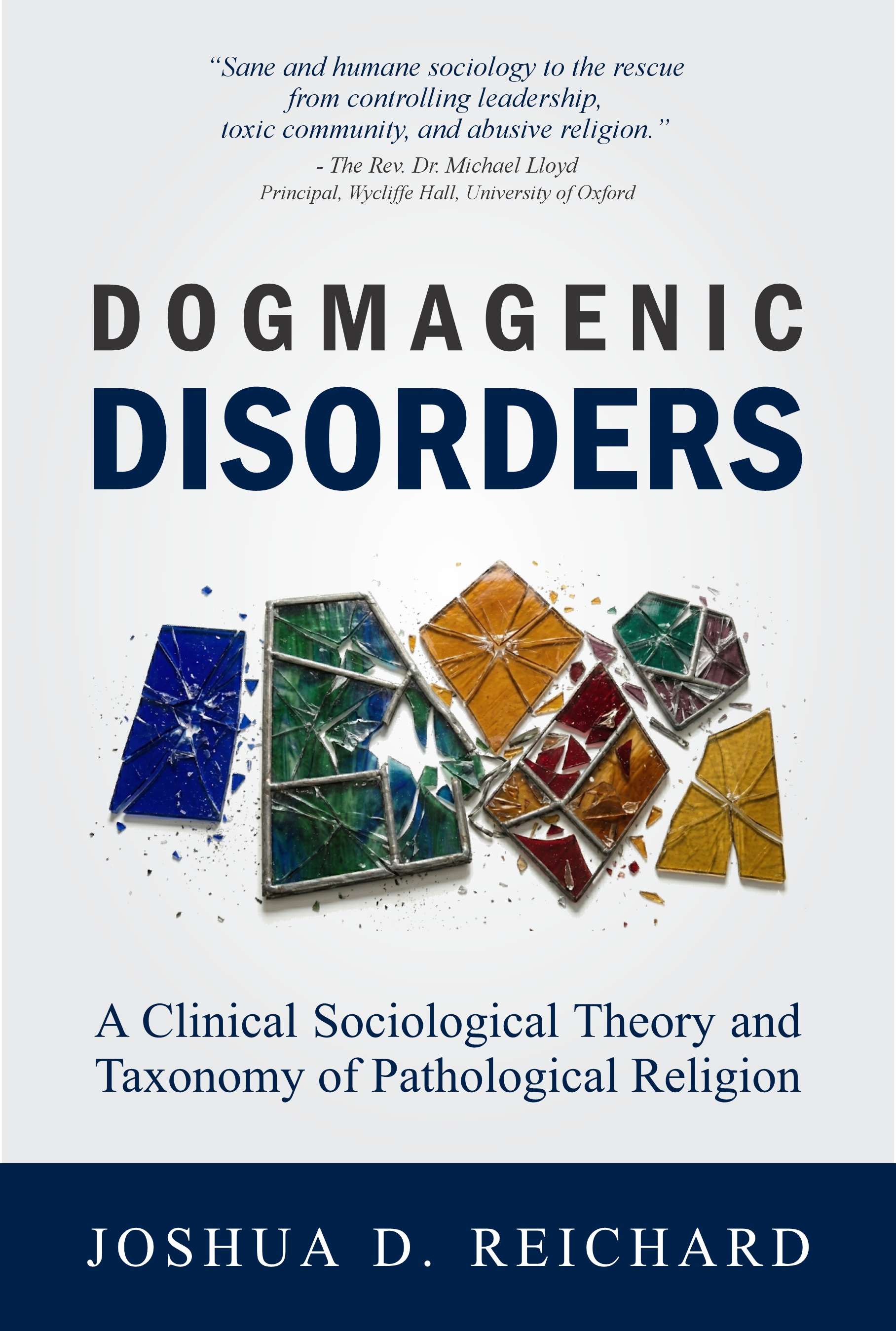
Dogmagenic Disorders: A Clinical Sociological Theory and Taxonomy of Pathological Religion, by Joshua D.
Reichard (2026), is a theory-driven framework for identifying, describing, and addressing patterns of
religious dysfunction that arise when dogma becomes the driver of group-level harm. Rather than
critiquing theological content, the book focuses on how belief is socially constructed, stabilized, and
enforced, and on the predictable consequences that follow when a group’s “Sacred Canopy” hardens
into a rigid system that undermines human agency, empathy, and adaptation.
Dogmagenic Disorders are systemic social dysfunctions in religious groups in which dogma is not
merely present but functions as the central etiological mechanism, stalling the group’s “social metabolism”
(its capacity to process experience, feedback, and pluralism) and producing real downstream harms for
individuals, relationships, institutions, and public life.
Analytical Framework
- Peter L. Berger's (social constructionism) dialectic (externalization → objectivation →
internalization) is used to explain how meaning-making communities construct a Sacred Canopy (nomos) that
shelters members from the fear of chaos (anomie), and how that same shelter can become pathological through
alienation, reification, and the practice of “Bad Faith.”
- W. I. Thomas (The Thomas Theorem) is used to treat each disorder as a “Definition of the Situation”
that, once socially defined as real, produces real consequences regardless of empirical veracity.
- Clinical sociology (application) translates theory into a diagnostic and intervention-oriented field
guide aimed at restoring agency, de-reifying institutional rigidity, and rebuilding a breathable,
ethically grounded Sacred Canopy (“Good Faith”).
What the Book Contains
Part One – Theoretical Foundations: Establishes vocabulary (Sacred Canopy, nomos/anomie, plausibility
structures, reification), explains mechanisms that stabilize rigidity (indoctrination, diminished agency,
groupthink, epistemic closure), and maps how defensive “fortress” dynamics emerge under pluralism and
social change.
Part Two – Clinical Field Guide: Presents a standardized diagnostic format (presenting dogma;
sociological etiology; group diagnostic criteria; consequences; differential diagnoses; interventions) and a
taxonomy organized by where the Bergerian “metabolism” stalls (externalization, objectivation,
internalization), including terminal systemic states.
Organized into four diagnostic clusters (Disorders of Externalization, Objectivation, Internalization, and Terminal Systemic States) the eighteen disorders range from Instrumentalized Sanctity Disorder, in which a Sacred Canopy is hijacked to serve a partisan political agenda, to Epistemic Closure Disorder, in which the group seals itself inside an echo chamber impervious to correction, to Total Systemic Collapse, in which the entire Social Metabolism of a religious group fails. Each disorder is presented in a structured clinical format: sociological etiology, group diagnostic criteria, Thomas Theorem consequences, differential diagnoses, and concrete intervention pathways for clinical sociologists and other practitioners.
Key Contributions
- Defines “Dogmagenic Disorders” as a specific subset of pathological religion where dogma is the
central causal engine (not merely a correlate of high-control dynamics).
- Integrates Berger’s constructionism with Thomas’s consequence logic and clinical sociology to
move from explanation to diagnosis and intervention.
- Offers “ideal type” categories intended for cross-tradition application without singling out
particular denominations or theological positions.
- Centers on predictable group-level mechanisms (boundary maintenance, epistemic policing, policy
reification, identity fusion) and their impacts on human flourishing, rather than adjudicating
doctrinal truth.
Intended Audience and Use
The book is written for sociologists of religion, applied/clinical sociologists, educators,
clergy, and organizational leaders, and readers seeking a conceptual map of dysfunctional
religious systems. It is designed to support:
- Scholarly discussion of religion’s meaning-making functions and failure modes in pluralistic
societies.
- Field identification of group-level patterns (diagnostic criteria) without reducing analysis to
individual pathology.
- Ethically oriented interventions that prioritize agency restoration, humanization of the “Other,”
and institutional transparency.


 Dr. Joshua D. Reichard serves as the President and CEO of Omega Graduate School, the American Centre for Research in the Social Sciences (ACRSS) and in various capacities in higher education. He is a Certified Clinical Sociologist and earned a PhD in Human and Social Studies (Religion and Theology) at the University of the Western Cape, a PhD in Technology Education at the University of South Africa, and a PhD in Social Research from Omega Graduate School. Dr. Reichard also has postgraduate degrees and certificates in Educational Leadership, Business, Data Science and Machine Learning, and Computer Science Education.